How did I approached the problem?
How can haptic feedback enhance the driver’s experience when interacting with the central display?
Can it, in particular, improve safety and elevate the perception of quality?
My role: Collaborating with my team and the client to design research questions that address these topics. This involved understanding the client’s needs, aligning with their requirements, and conducting a thorough review of the literature to establish the state of the art in this field.
Testing Interactions with the HVAC Panel.
My role: Partnering with the client’s team to understand the interaction logic of their existing design and its integration with haptic feedback. This involved reviewing their internal documentation to effectively adopt and optimize the use of haptic feedback in the system. This phase was particular important for the protocol definition.
Within-Subjects Design A/B Testing with 40 participants;
Conditions: Stationary and driving;
Data Collection Methods: Mixed methods, including surveys, semi-structured interviews, and biometric data (eye-tracking).
My role: Defining the tasks participants would have to perform. Defining key parameters for data collection through both quantitative methods (self-assessment surveys) and qualitative methods (semi-structured interviews). My active participation during this phase was critical in shaping the test setup and ensuring its alignment with research objectives.
Test setting included: digital interactive prototype on the central display, driving simulation scenario and equipment for data collection, including biometric devices and computers.
My role: Designing and developing the prototype for the central display. This involved starting with the client’s screen designs in Sketch, importing them into Protopie to create advanced interactions, and integrating them with Protopie Studio to enable haptic feedback functionality.
Participants were involved in the test in full compliance with GDPR privacy regulations. The entire test process was recorded for later analysis.
My role: Actively participating in conducting the test, with a primary focus on facilitating the final interview. The most challenging aspect of this phase was maintaining a neutral tone to avoid influencing participants and ensuring unbiased responses.
The findings indicate that haptic feedback improves safety perception and reduces task completion time when activated. It was also perceived as a feature that enhances the overall quality of the interaction.
My role: Collaborating on the analysis of data from surveys and interviews, integrating these findings with biometric data results. The most challenging yet rewarding aspect of this phase was generating actionable insights by synthesizing and interpreting the diverse data sources.
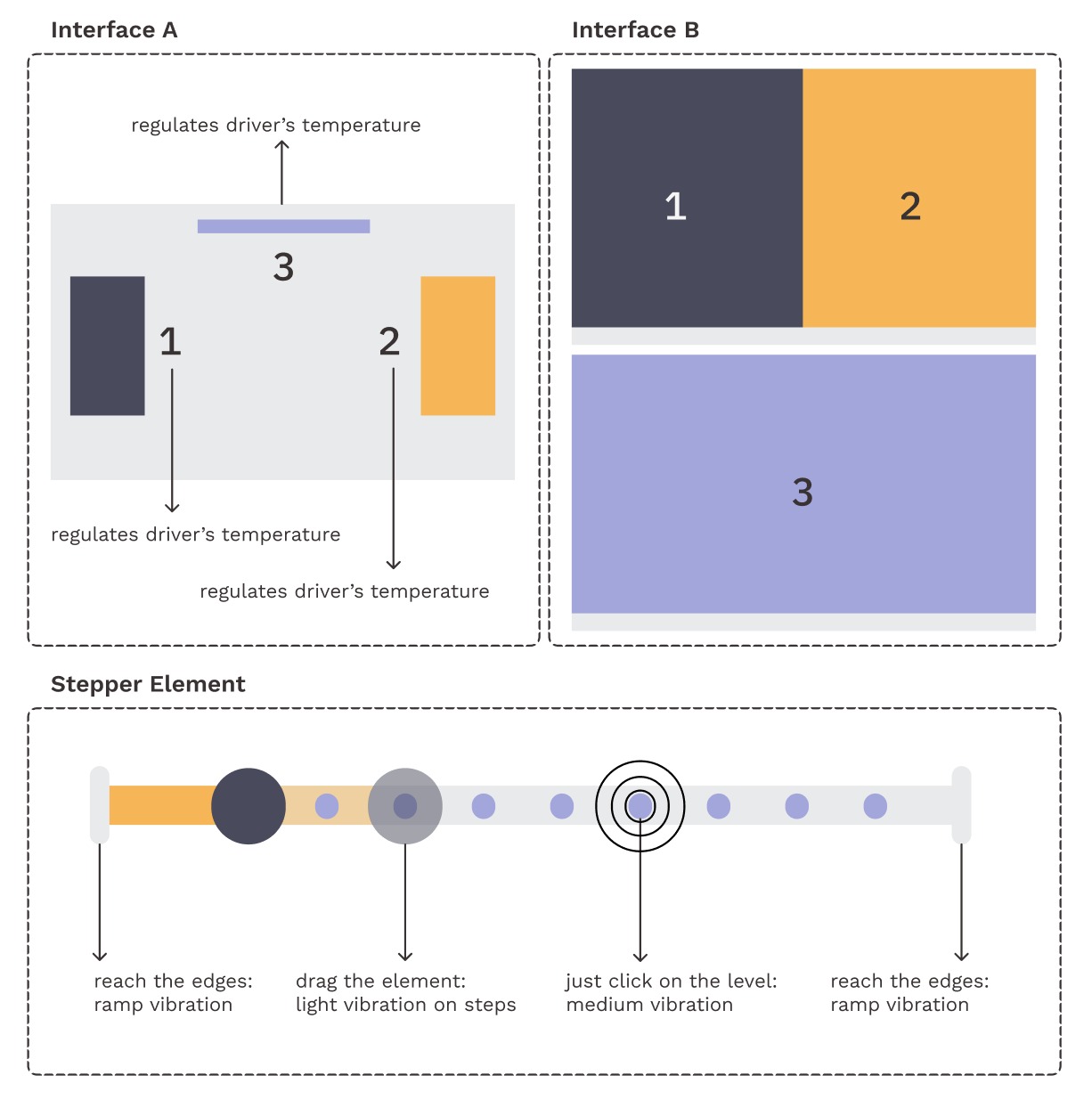
The prototype was designed to be functional for experimentation, so tasks were chosen that would allow the user to experience these different feedbacks.
I learnt how to develop a prototype on multiple platforms, adding layers of detail, from Sketch to Protopie Studio to Protopie Connect.

For example users had to express their safety perception while interacting with the touchscreen with and without haptic feedback. This was expressed on a 7 point Likert scale, but then crossed with results coming from eye-tracking glasses.
Touchscreens certainly allow car manufacturers to include more and more functions, but how many of these are actually used by users?
It is true then that haptic feedback helps the user to improve the touchscreen experience, but still it remains only confirmatory feedback: user can evaluate what has just happened?
Physical buttons on the other hand can work in the gulf of execution: user finds the knob and knows exactly what they have to do.